Heads up: the founder in this story is a composite, not a real client, and the budget figures are examples to make the maths easy to follow.
Let me tell you about a founder I will call Karthik. He runs a small D2C brand out of a Koramangala flat. He read three blog posts, watched one YouTube tutorial and decided to run Meta ads. He set ₹500 a day, hit “Boost” on his best-looking reel, and waited.
Ten days later he had spent ₹5,000, collected about 400 likes, and made two sales. One was his cousin.
Karthik’s story is painfully common. The platform is not broken. His setup was. If you are thinking about Meta ads in Bengaluru, or you tried once and gave up, here are the five places the money usually leaks.
Leak 1: Boosting instead of building a campaign
The blue “Boost” button is convenient, and it is built to get you engagement. Engagement is fine if you want likes. It is not fine if you want enquiries or purchases.
Using Ads Manager lets you choose the actual goal: leads, sales, calls or messages. When you tell Meta you want buyers, it hunts for buyers. When you tell it you want likes, it hunts for likers. Same budget, very different crowd.
Leak 2: Targeting “everyone in Bengaluru”
Bengaluru has well over a crore people. Your product is not for all of them. Yet many first campaigns target the whole city, ages 18 to 65, all genders, all interests. That is like shouting your offer on MG Road and hoping the right person is listening.
Start tighter. Think about who has actually bought from you, where they live (HSR, Indiranagar, Whitefield, Electronic City each behave differently), and what they care about. Then let the platform widen it once it has data.
Leak 3: A great ad that sends people to a bad page
This is the sneakiest leak. The ad is catchy, the click is cheap, and then the person lands on a slow page, a confusing homepage or a form with nine fields. They leave. You paid for the click and got nothing.
Before you spend a rupee, test the journey on your own phone, on mobile data, not Wi-Fi:
- Does the page load in a few seconds?
- Can you tell what to do within five seconds?
- Is the form short (name, phone, one question is often enough)?
- Does a WhatsApp or call button work in one tap?
Leak 4: Changing everything every two days
Meta’s system needs time to learn. If you edit the budget, audience and creative every 48 hours because you are nervous, the campaign never settles. It is like pulling a plant out every day to check if the roots are growing.
Give a test campaign at least five to seven days unless something is clearly broken, and change one thing at a time so you actually know what worked.
Leak 5: No tracking, so no learning
If you cannot say which ad produced which enquiry, you are guessing. At the very least, install the Meta Pixel, track your key action (form submit, WhatsApp click, purchase) and note down enquiries by source every week. A simple spreadsheet beats nothing.
What a calmer first month looks like
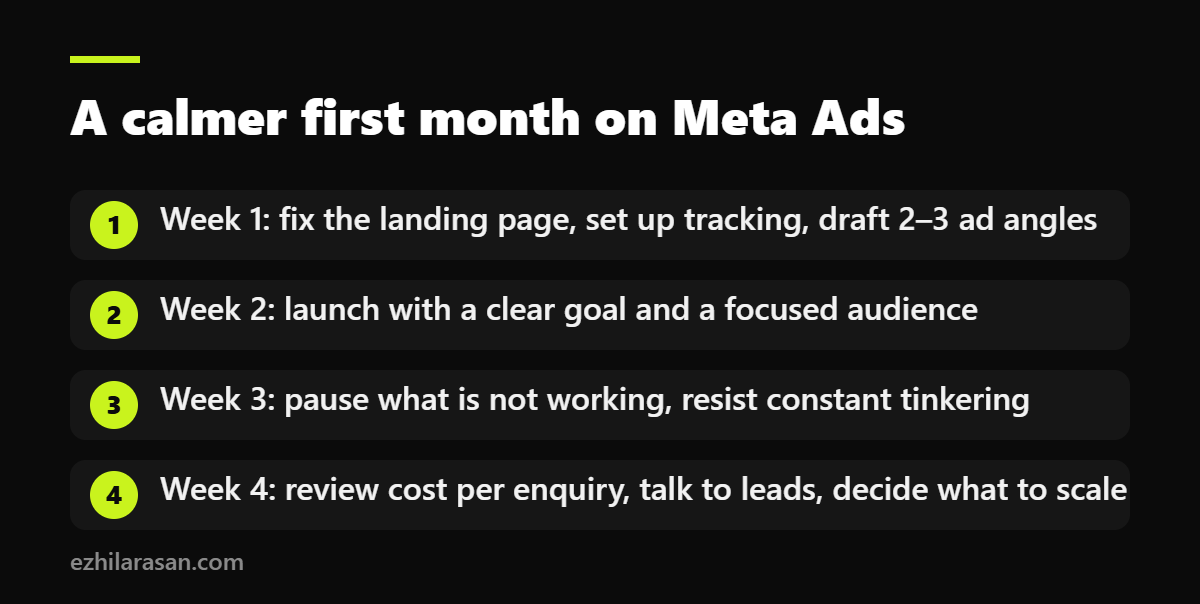
Here is how I would suggest a first month for a small budget, say ₹300 to ₹500 a day:
- Week 1: fix the landing page, set up tracking, write two or three simple ad angles
- Week 2: launch with a clear goal, a focused audience and two or three creatives
- Week 3: switch off what clearly is not working, keep what is, resist tinkering
- Week 4: review cost per enquiry, talk to the leads you got, decide what to scale
Notice that “spend more” does not show up until the end. Scaling a leaky campaign just leaks faster.
One honest warning
No blog post, including this one, can promise you a particular return. Results depend on your product, price, offer and competition. Anyone who guarantees you a fixed ROAS before seeing your business is selling hope. What you can do is test cleanly, learn quickly and stop paying for things that do not work.
If you want help setting this up properly, that is what my Meta ads management service covers: planning, setup, creative testing and optimisation for businesses in Bengaluru and Chennai. If you would like to talk through your budget and goals first, you can reach out here. No pressure, and no jargon.
October 30, 2026
Why Your Instagram Has Followers but No Customers...

October 30, 2026